
Illustrative studies
Examples of our approach
Explore how Fox Healey & Co approaches commercial challenges in manufacturing and engineering: protecting specifications, improving distributor productivity and selecting growth opportunities the business can deliver.
Study 01
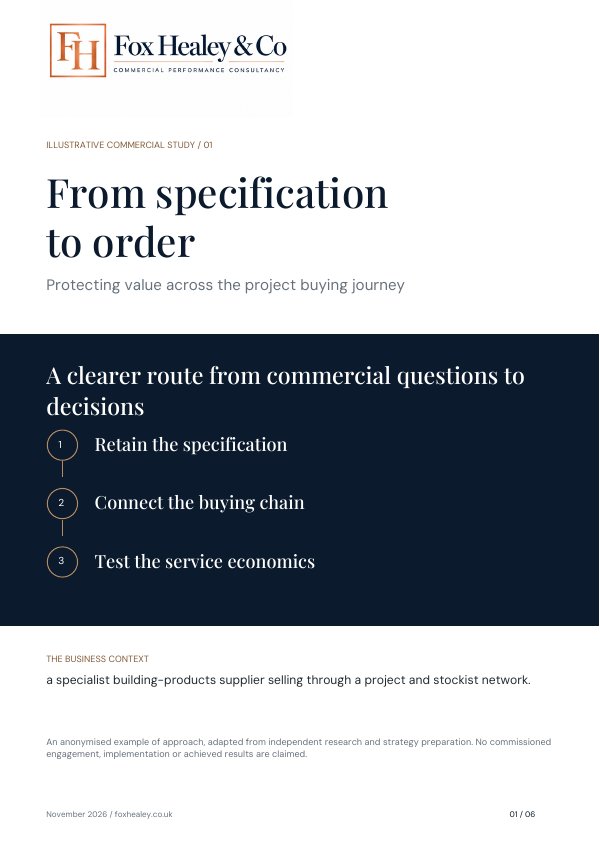
From specification to order
Audience: Project-led manufacturers and specialist building-products suppliers.
Winning a specification is only one stage in securing an order. Designers, contractors, purchasers, stockists and installers may each influence the final choice. This study explores how to connect those decisions, understand why substitutions occur and provide useful information throughout the buying journey.
The proposed approach combines project tracking, stakeholder feedback, controlled documentation and a manageable pilot. The commercial test is whether better continuity protects demand and contribution without creating disproportionate support costs.
Key takeaways
- Map decision makers and handovers.
- Identify the evidence behind lost specifications.
- Test retention and support economics together.
Questions to examine
- Can we trace each specification, quotation and order to the same project without counting it more than once?
- Which reasons for substitution are documented, and which are still assumptions?
- Does retained contribution justify the additional support and fulfilment costs?
Study 02
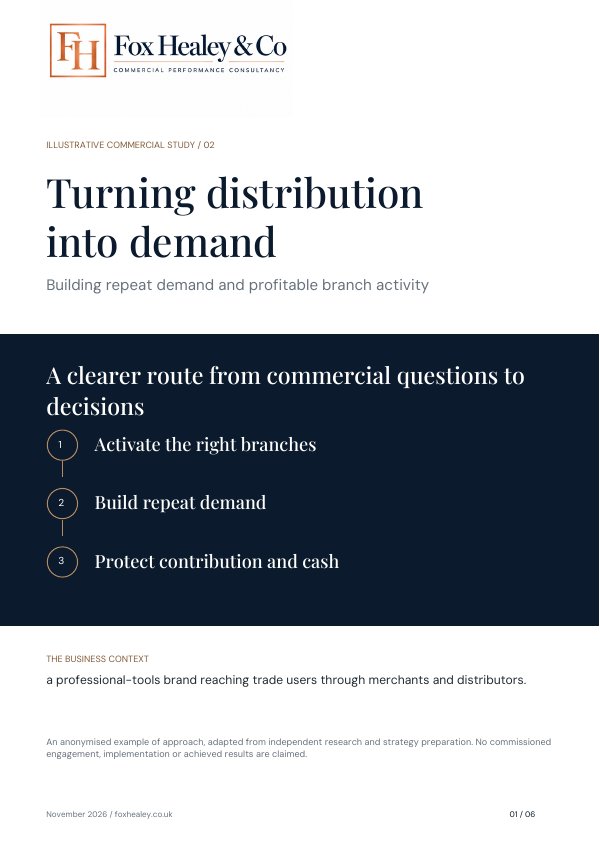
Turning distribution into demand
Audience: Manufacturers and product brands selling through merchants and distributors.
A distributor listing does not establish sustained customer demand. This study separates branches that list a product from those that stock, recommend, sell and reorder it. It explores how a focused range, practical demonstrations, branch support and reliable replenishment could improve productive distribution.
A regional pilot would test repeat demand alongside contribution, support effort and stock exposure. Opening orders alone would not be treated as proof of success.
Key takeaways
- Distinguish listings from productive branches.
- Connect product value with trade-user needs.
- Assess repeat orders, contribution and cash together.
Questions to examine
- Which branches are reordering within an observation window that fits their replenishment cycle?
- What contribution remains after rebates, freight, returns and incremental branch support?
- Are shipments being followed by sell-through and replenishment, or mainly adding stock?
Study 03
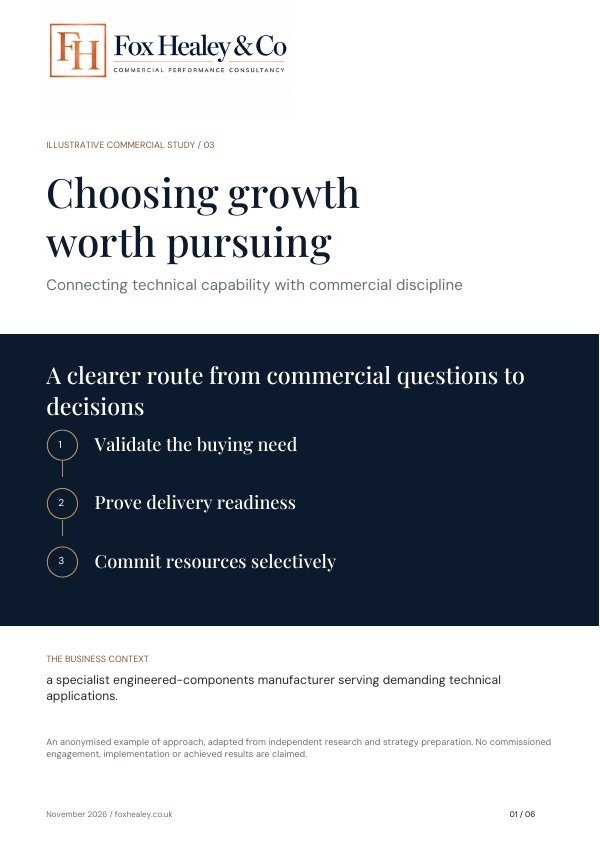
Choosing growth worth pursuing
Audience: Specialist engineering and technical-component manufacturers.
A technically attractive opportunity is not automatically a commercially attractive one. This study explores how to compare customer need, technical fit, qualification effort, delivery capacity and commercial exposure before committing resources.
Sales, engineering, operations and finance would work through explicit approval gates, supported by customer discovery and documented assumptions. The intended output is a defensible decision about which opportunities to pursue, validate further, reshape or decline.
Key takeaways
- Translate product capabilities into customer buying reasons.
- Establish technical and delivery readiness.
- Evaluate contribution, development effort and cash exposure.
Questions to examine
- What evidence confirms a buying need and a realistic procurement route—not just a large potential market?
- Which qualification or delivery requirements could affect commitments to existing customers?
- What change in development cost or cash exposure would make us revisit the approval decision?
Where could your commercial performance improve?
A free Commercial Performance Snapshot gives you an initial, structured view across six commercial pillars, so you can see where attention is likely to matter most.